Ice at the eaves and water on the ceiling
Ice dam damage on Harrison roofs
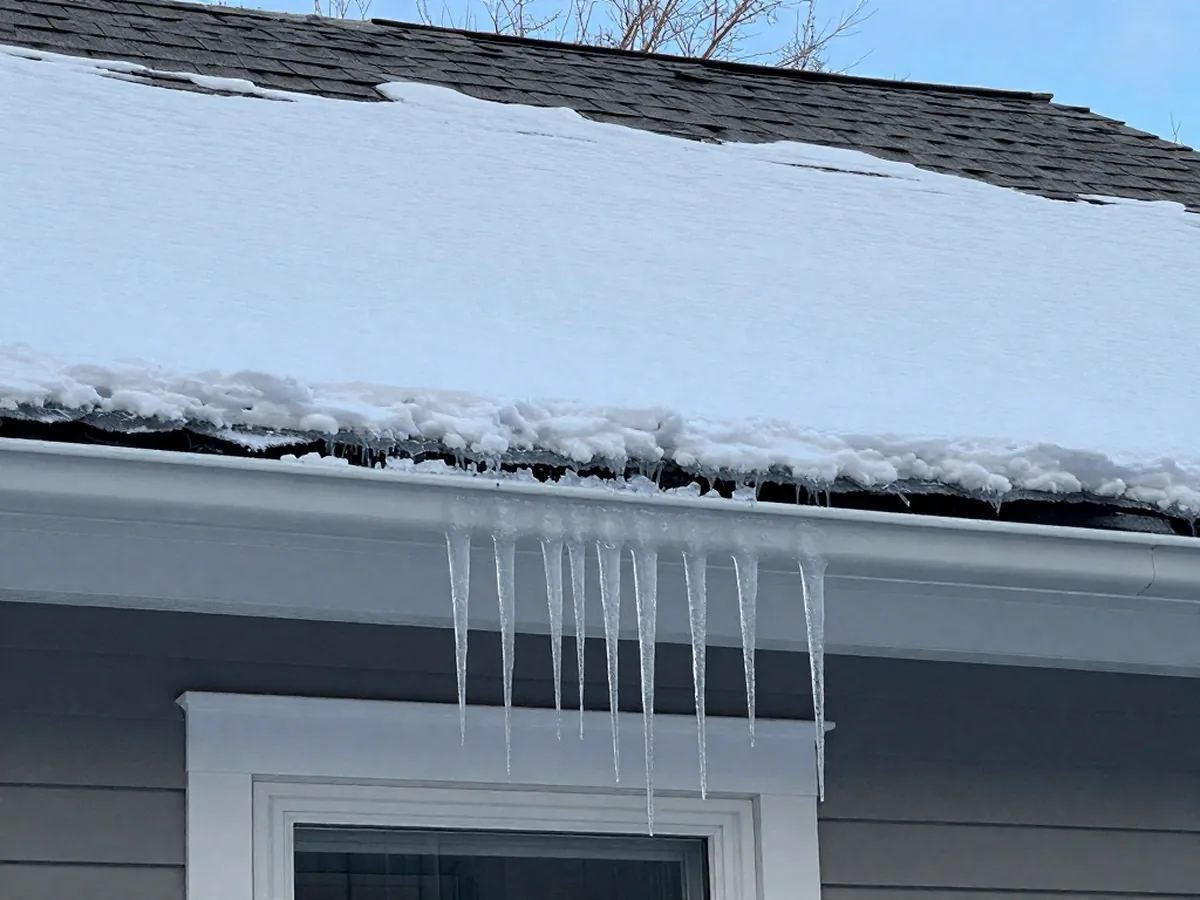
An ice dam on a Harrison roof is a ridge of ice along the edge that traps melting snow behind it. Your move: call (862) 418-5296 if a stain showed up inside, and say where the ice sits.
Back away and get help if
- Icicles or a ledge of ice hanging over an entrance or path: keep people and pets from standing below.
- A hammer aimed at roof ice: do not go up to chip it. Shingles crack, and the surface is slick.
- A wet or bulging ceiling under the ice: keep people from standing under it and dial 911.
- Water dripping from a light fixture or beside an outlet on the ceiling: keep clear of the whole room, then dial 911 from another part of the house.
The melt-and-refreeze cycle, step by step
Heat from the house rises into the attic and warms the roof deck. Snow on the upper roof melts, runs down to the cold eave and refreezes there. Ice piles up, water backs up behind it and can slip under the shingles.
The Building America Solution Center puts air sealing first, then insulation and ventilation, and notes that snow itself insulates only at R-1 to R-2 per inch. The University of Massachusetts building-science article rules out gutters as a cause.
Around Harrison and next door
Newark Airport's January normals run 32.8 degrees for the average day, 40 for the high and 25.5 for the low. Ice dams need melt in the afternoon and a refreeze at night, and a typical January day straddles freezing.
Kearny has 5,873 homes built in 1939 or earlier and Harrison has 2,007, per the Census Bureau. In the Building America Solution Center's order of work, air sealing and insulation come first, and a roofer looking into an old attic can see how much of either is there.
The airport's record January day for snow is 24 inches, on 23 January 2016, and its snowiest January brought 37.4 inches in 2011.
February thaws and freezing nights
February averages 35.1 degrees at Newark Airport; the 1991-2020 normals give a 43-degree high, a 27.2-degree low and 10.1 inches of snow. A thaw above freezing followed by a freezing night is what the cycle runs on.
Heat tape is a common reaction. The University of Massachusetts article says it can create a dam above itself, and that chipping ice does more harm than good.
What to look at with feet on the ground
Everything here can be done from the ground or through a window. A job that needs a ladder belongs to the roofer.
- Photograph the ice from the ground: how far it runs along the eave and how thick it is. Leave the hammer in the shed.
- Inside, check the top-floor ceiling along the outside walls for new stains or paint that has started to bubble.
- On a cold day, look into the attic from the hatch. Frost clinging beneath the roof boards points to warm air leaking up from the house.
- Note which slope grows ice first and how many days the snow stays up there. A roofer can read that pattern.
A code bulletin, with a caution
A 2015 state code bulletin applied the ice-dam membrane rule only where the January mean sits at 25 degrees or lower, which in New Jersey meant Sussex County. Newark's January average is 32.8.
Newer code editions may have changed the rule, so a roofer or the town office has the current answer. Checking a contractor lists the offices.
Ready to describe the roof?
Ready for the call: the street address, where the damage shows and a guess at the roof's age. Dial (862) 418-5296. Renters: the dated photo goes to your landlord or property manager at the outset. Covered: Harrison, Kearny, East Newark and Newark.
Call (862) 418-5296